This is the final entry of my 2012 Blog...
Once I started chasing rare birds, and it picked up considerably in the second half of the year, I would tell people, "I'm just here for the bird," meaning the specific one that had been reported, such as the Pink-footed Goose or Tufted Duck, say. So in the spirit of that ethereal idea, you can, if you wish, join me in my future birding adventures at: justhereforthebird.blogspot.com
Thanks to everyone who has followed my 2012 Big Year and thanks for all the great comments and congratulations throughout the year. I would never have made it without your support.
Saturday, 5 January 2013

Friday, 4 January 2013
These Are Some of My Favourite Birds
The tough birds I found all on my own are some of my favourites, such as the Northern Lapwing, Nutting's Flycatcher, Tufted Duck, Barnacle Goose, and especially the Pink-footed Goose. I loved spotting the Sooty Grouse, White-headed Woodpecker, Rufous-backed Robin and Western Spindalis all on my own. I loved all the Flycatchers, especially the elusive Fork-tailed Flycatcher and the beautiful Vermilion Flycatcher. The Hummingbirds were particularly beautiful, including the Plain-capped Starthroat I saw at the Ash Canyon Bed and Breakfast and the Allen's at Babe's place. If I had to pick a favourite duck, it would be the Northern Pintail.
And I want to some day see all the owls. Not just in North America, but everywhere. I never realized how many species of owls there are,(224), and how beautiful they can be. I loved the Barn and Boreal Owls. And I won't forget the Whooping Cranes or the satisfaction of finding the Audubon's Oriole in Texas and the MacGilvary's Warbler after a long search on a chilly day in Boston. And I could look at Waxwings all day. Very elegant birds. But there was an even more elegant bird.
All three species of Puffins probably came a close second to my favourite bird of the year. I saw Tufted and Horned on a pelagic out of Seward, Alaska and Atlantic Puffins in Newfoundland. They were great birds all, wonderfully cute, but I was taken to them, rather than finding them on my own. So, they end up a close second.
The winner as my favourite bird of the year, for its rarity, the time spent looking for it, the satisfaction of finding it and it's shear beauty, has to be the Elegant Trogon. I looked for it on two occasions up at the Cary Nation Trail in Madera Canyon, both alone and with Matt Brown. And then, on my last day in Arizona for the year, one was spotted in my favourite birding spot in North America, Patagonia Lake State Park.
I rushed over there, and had about 3 hours to find it before I had to drive back to Tucson to get to the airport and catch a flight. I walked the stream bed for nearly the entire three hours when I turned my head in the exact right direction at the exact right time and there it was, not 10 feet in front of my nose. And it neither of us got spooked. I took photos, the Trogon posed for said photos. It was one of the more exciting birds of the year, though finding the Rufous-backed Robin got me pretty pumped too.
Below, the Elegant Trogon, and some photos from the last few days of the year, followed by some of my favourite birds in the last half of the year.


And I want to some day see all the owls. Not just in North America, but everywhere. I never realized how many species of owls there are,(224), and how beautiful they can be. I loved the Barn and Boreal Owls. And I won't forget the Whooping Cranes or the satisfaction of finding the Audubon's Oriole in Texas and the MacGilvary's Warbler after a long search on a chilly day in Boston. And I could look at Waxwings all day. Very elegant birds. But there was an even more elegant bird.
All three species of Puffins probably came a close second to my favourite bird of the year. I saw Tufted and Horned on a pelagic out of Seward, Alaska and Atlantic Puffins in Newfoundland. They were great birds all, wonderfully cute, but I was taken to them, rather than finding them on my own. So, they end up a close second.
The winner as my favourite bird of the year, for its rarity, the time spent looking for it, the satisfaction of finding it and it's shear beauty, has to be the Elegant Trogon. I looked for it on two occasions up at the Cary Nation Trail in Madera Canyon, both alone and with Matt Brown. And then, on my last day in Arizona for the year, one was spotted in my favourite birding spot in North America, Patagonia Lake State Park.
I rushed over there, and had about 3 hours to find it before I had to drive back to Tucson to get to the airport and catch a flight. I walked the stream bed for nearly the entire three hours when I turned my head in the exact right direction at the exact right time and there it was, not 10 feet in front of my nose. And it neither of us got spooked. I took photos, the Trogon posed for said photos. It was one of the more exciting birds of the year, though finding the Rufous-backed Robin got me pretty pumped too.
Below, the Elegant Trogon, and some photos from the last few days of the year, followed by some of my favourite birds in the last half of the year.


Wednesday, 2 January 2013
Breaking Down The Big Year
One of my favorite things is making lists and categorizing things. That's why I love baseball, it's all about the statistics. That is why I wanted to do a Big Year, rather than just go look at birds. I've always looked at birds and have loved photographing them for over 20 years now, but never really knew more than a handful of species names, mostly Blue Jays and and Cardinals. The idea that you could go out and make a great, big, long list of birds, seeing and identifying new ones nearly every day for one calendar year, in a wide range of habitats, is what sent me over the edge. When I saw the movie, The Big Year, I knew I had the personality traits of all three of the men depicted in the movie. I knew I would be not just a bird watcher, not just a birder, but an extreme birder, a Lister.
So, by the numbers, here is a look back at everywhere I went and everything I saw in 2012. Frustratingly, two birds appeared in Florida just after I left; both had been high on my list for getting in Florida in 2012, the Thick-billed Vireo, which I am reasonably sure I saw the previous day, and was confirmed just after I left, and the LaSagra's Flycatcher which I was two days late for in March. Drat. But time to move on, and as such, I present my 2012 statistics:
605: Total Life List, including Dusky Grouse in Montana, Roadside Hawk in Belize and Red-billed Streamertail and Jamaican Mango in Jamaica.
601: Total Species Seen and heard
596: ABA Countable Species seen and heard
547: Life birds added in 2012,(my previous Life List came from spending an evening identifying birds in photographs I had taken over the years).
17: States visited
3: Provinces visited
139: in Florida (190 for the State)
110: in Arizona (167 for the State)
93: in California
45: in Texas
20: in Alaska
12: in Nevada
5: in each of Louisiana and New Jersey
4: in Massachusetts
3: in each of Minnesota and Pennsylvania
1: in each of Connecticut, Delaware, Maryland, Michigan, Missouri and West Virginia
147: in Ontario (235 for the Provence)
8: in Newfoundland
2: in British Columbia
45 Species of Wood Warbler,(I am not sure I knew they even existed before I began my Big Year).
38 Species of Emberizids,(This includes Sparrows, Towhees, Buntings and Juncos, and I had thought nearly every bird was just a "regular sparrow").
36 Species of Flycatcher,(I had only ever heard of the Nutting's Flycatcher from "The Big Year").
19 Species of Woodpecker,(I had only known of 3 previously).
16 Species of Owl,(I had never seen one outside a zoo prior to this year).
15 Species of Hummingbird,(I had only seen 1 in North America and 2 in Jamaica prior to 2012, but they have always been my favorite birds to watch and photograph).
21 Rodent-y Things,(see Tab above).
I also flew and drove untold thousands of miles, walked and biked hundreds miles,(probably close to a thousand), boated hundreds of miles,(and was seasick on 3 of 6 boat and ferry trips).
I don't want to think of the money I spent. So this is where I will stop.
I shall think of my favorite birds of the year, but Puffins are up there, along with Pink-footed Goose and Fork-tailed Flycatcher.
More to come...
So, by the numbers, here is a look back at everywhere I went and everything I saw in 2012. Frustratingly, two birds appeared in Florida just after I left; both had been high on my list for getting in Florida in 2012, the Thick-billed Vireo, which I am reasonably sure I saw the previous day, and was confirmed just after I left, and the LaSagra's Flycatcher which I was two days late for in March. Drat. But time to move on, and as such, I present my 2012 statistics:
605: Total Life List, including Dusky Grouse in Montana, Roadside Hawk in Belize and Red-billed Streamertail and Jamaican Mango in Jamaica.
601: Total Species Seen and heard
596: ABA Countable Species seen and heard
547: Life birds added in 2012,(my previous Life List came from spending an evening identifying birds in photographs I had taken over the years).
17: States visited
3: Provinces visited
139: in Florida (190 for the State)
110: in Arizona (167 for the State)
93: in California
45: in Texas
20: in Alaska
12: in Nevada
5: in each of Louisiana and New Jersey
4: in Massachusetts
3: in each of Minnesota and Pennsylvania
1: in each of Connecticut, Delaware, Maryland, Michigan, Missouri and West Virginia
147: in Ontario (235 for the Provence)
8: in Newfoundland
2: in British Columbia
45 Species of Wood Warbler,(I am not sure I knew they even existed before I began my Big Year).
38 Species of Emberizids,(This includes Sparrows, Towhees, Buntings and Juncos, and I had thought nearly every bird was just a "regular sparrow").
36 Species of Flycatcher,(I had only ever heard of the Nutting's Flycatcher from "The Big Year").
19 Species of Woodpecker,(I had only known of 3 previously).
16 Species of Owl,(I had never seen one outside a zoo prior to this year).
15 Species of Hummingbird,(I had only seen 1 in North America and 2 in Jamaica prior to 2012, but they have always been my favorite birds to watch and photograph).
21 Rodent-y Things,(see Tab above).
I also flew and drove untold thousands of miles, walked and biked hundreds miles,(probably close to a thousand), boated hundreds of miles,(and was seasick on 3 of 6 boat and ferry trips).
I don't want to think of the money I spent. So this is where I will stop.
I shall think of my favorite birds of the year, but Puffins are up there, along with Pink-footed Goose and Fork-tailed Flycatcher.
More to come...
Tuesday, 1 January 2013
It Was a Very Good Year
When I was 52, it was a very good year. It was a very Big Year
full of lots of great birds, on cold winter days and long summer walks.
And now, it is done. I birded from sunrise on January 1 until it was dark on December 31. I set out to do something no one else had ever done, begin birding with a Big Year. For 366 days I was a bird watcher possessed. There were times when I was standing in the middle of a field on a hot July afternoon in Texas, with sweat snaking down my legs and into my shoes, asking myself what the heck I was doing, and there were times where I was jubilant with the triumph of finding the one bird I was searching for after hours of scanning the trees or ponds or empty fields.
And I met the most extraordinary people along the way. Birders, each and every one, are some of the nicest people you will ever meet. I never met a birder I didn't like. There was Fred in Hamilton who was one of the first birders to take me under his wing, back in January. The professional guides I hired along the way, Melody Khel, Matt Brown, Eddie Bartley, Hutch Hutchenson and Ken in Alaska. I met the kindest of strangers, sometimes the middle of nowhere chasing rare birds posted on NARBA and e-bird, such as Hemant, whom I ran into in Texas and Arizona and Edna, Ray and Sandy from New Jersey. And finally, John Hargrove, doing his own Big Year at the age of 69, with whom I birded on two pelagics on opposite coasts, and on the final days of the Big Year down in Florida, by phone and text with his wife Beverly, as we chased down the Western Spindalis, but missed the Thick-billed Vireo,(actually, crazy as it might sound, I believe I did see the vireo the on the morning of the 30th in Fort Zachary Taylor, where I had started the day looking for White-crowned Pigeons, but failed to realise what it was and didn't get a diagnostic photo of for confirmation. Carl, whom I met later that morning at the Key West Botanical Gardens, found it yesterday, photographed and identified it. I was already in Maryland when I found out, and John and Beverly were too far away from the Keys to chase it down themselves). Oh, and I shouldn't forget Sandy Komito, who was nice enough to keep in touch via e-mail a few times during the year with advice and inspiration.
I know that sometimes I was inaccessible to friends, coworkers and family who must have thought I was out of my mind to just pick up one day and devote myself to a single minded goal at, sometimes, their expense,(especially Sue who had to put up with this obsession for 366 days herself). But in the end I have no regrets and have learned and seen so much and accomplished more than I set out to do when this all began.
Quite Frankly, the day I decided to attempt a Big Year, 300 species was the goal, just birding here in Ontario and wherever I travelled for work. By the end of January I was hooked and knew that this quest had become bigger than I imagined and more important to me than I would have thought possible. It was the near impossibility of seeing 600 birds that pushed me into going to Alaska, Arizona five times and Texas on four occasions. To the Florida Keys, the Dry Tortugas and the rice fields of Louisiana. To Newfoundland in July and California in January and September. It drove me to take long pelagic boat trips where sea sickness made me question why anyone would put themselves through such agony just to see one more bird.
And speaking of one more bird, my final birding trip of the Big Year was to Cape May NJ to find a Dovekie. I flew from Miami on the morning of the 31st to Baltimore, where I had left my car, then drove to Lewis, Delaware to catch the ferry to Cape May and Sunset Beach. I did not get sick on the hour and half ride and was treated to an amazing show of Gannets and Scoters. I enjoyed just watching the birds so much it didn't really matter that, as the sun set on my big year, I didn't see the Dovekie. What mattered was that I never gave up. What mattered was that after 12 months of chasing, of just being there "for the bird," just seeing the birds that were there to see on the ferry and at the beach, was satisfaction enough. Sue, and a few others that view "listers" as birding pariahs, would be proud of me, I think.
That doesn't mean I will stop chasing. Not by a long shot. Another birder I met this year, Andrew, who did an Ontario Big Year, e-mailed me back, after I congratulated him on his year, saying that my goal for this next year should be to see 50 species I missed in 2012. He said it wasn't his idea, but those were just the rules. I will confine the chasing to inexpensive local trips and birds close to where I am at the time for the next few years. Then, when and if one day, I have sufficient time, money and birding knowledge, perhaps when I am closer to 65 than to 55, I will go out and break Sandy Komito's record,(if Sue lets me, that is).
So, as I wrote in my last blog, I end the year with 596 ABA countable birds, plus 5 that those pesky folks at the ABA have deemed not wild enough to list. The only birds I had seen prior to 2012 that I didn't see this year, were a Roadside Hawk and Dusky Grouse, and two Jamaican Hummingbirds. Could I have seen more? Yes. If I knew a year ago today, what I know now, I'd have not made at least a dozen stupid, rookie mistakes and would have easily passed 600. I made way too many tactical errors that cost me a dozen species, at least. Starting out, I had no road map to follow and didn't have 30 years of birding experience most birders have when they throw themselves into a Big Year.
In the end, I hope this inspires people to take the leap from just casual birdwatching to birding, and will serve as both a road map and a warning as to what they might be getting themselves into. There is a cost, both in the pocket book and in your personal life that goes along with this kind of quest, but in the end is worth every dollar spent, every day spent in the field and, in my case, all those nights spent sleeping in my car. I will have more to say tomorrow and in the days that follow, and put up some of the photos I have taken the last week that I haven't had time to sort through. Oh, and I'll submit my list to the ABA and see if I made it in the top 10 of North American Big Year Birders.
Sunday, 30 December 2012
Putting a Positive "Spin" on Things
"I have always depended on the kindness of strangers."
Blanche DuBois, A Street Car Named Desire
And it was no truer than today, as Beverley, the wife of John who is about to win the 2012 Big Year, helped me find accommodations in a camp ground last night so I didn't have to sleep in my car on the side of the road and end up in jail. Instead, I slept in my car in a secure and protected campsite right next to the washroom and shower facilities. Beverly also advised me as to where she saw the Western Spindalis in Key West Botanical Gardens, so I didn't have to end up spinning my wheels, so to speak, this morning.
So, a lucky break last night and another lucky break this morning in the botanical gardens, as I met Carl Goodrich, one of the birders who discovered the Spindalis. Nothing new to him, he's seen them many times before in the Bahamas and Cuba as well as here in Florida. He showed me all of the trees the bird has been seen in and we searched together for an hour without finding anything. So we split up. He took the inner depths of the park and I went back to where he had seen it yesterday, along the boardwalk. And as I walked along the boardwalk, looking into the big Fig tree, an olive-drab bird alighted on a branch in the next tree, not 10 feet from my face.
I didn't even need binoculars to identify what might have passed for an odd, boring little bird, had I not been specifically looking for a female Western Spindalis. As I brought my camera up for what would have been an amazing photo, it flew across the boardwalk and disappeared into another tree. It called a couple of times and that was also a means of confirmation. There was another birder present, Bo Howes, who checked his field guide as I checked my eBird App to doubly confirm it.
I went and found Carl and together we chased it from tree to tree trying to get photographs. This was the third day Carl has come to photograph the bird without success, so I don't feel too bad about missing the photo myself. I was just thrilled to have found it on my own. At the start of the year, after having seen the movie that got all this going, there were three birds I wanted to see this year: Nutting's Flycatcher, Pink-footed Goose and Western Spindalis. Well, four if you include the Xantus's Hummingbird, but my trip for the Allen's kind of emulated that movie experience. So in a manner of speaking, I got them all.
Before we parted company, Carl gave me a tip on where to see a White-crowned Pigeon. I've heard that before but over a morning of birding, I came to trust him. He sent me up to Key Largo and told me I'd likely see one flying over. He was right on. I saw my first White-crowned Pigeon almost exactly where he said I would. A good morning of birding resulted in birds number 594 and 595. I spent the rest of the day looking for and not finding White-winged Parakeets and Red-whiskered Bulbuls.
No worries. I will end the year with no fewer than 596 birds for the ABA area, plus 5 non ABA birds, giving me 601 in total. I will also leave Florida, having seen 189 species of bird here, this year.
Is there an award for Rookie of the Year in birding?
Tomorrow is a bonus day. Because of leap year, December 31 is day 366 of 2012. So I might as well keep going until tomorrow evening, when the sun will set on my first Big Year.
Good night, from Miami, and thanks to everyone who has helped and put up with this crazy adventure.
Saturday, 29 December 2012
From Maryland to Key West in a Day, with Nowhere to Stay
I am sitting in a McDonald's where my considerable luck has finally run out. I had been lucky to get the Allen's Hummingbird with relative ease yesterday morning, after having survived some white knuckle driving down there the previous evening. I even got a great dinner for under ten dollars at a roadside dinner.
My luck continued as I drove from Pipersville to Kent Narrows and I was scoping the cove behind the Holiday Inn Express by 12:45 yesterday afternoon. The weather was nice and the sun kept popping out, and within an hour I had finally caught the Tufted Duck in my scope. Trouble was it wouldn't sit still. For the 20 or so minutes that I was observing it, it kept diving, never staying in my scope for more than 10 seconds at a time. I had been told that it was doing exactly that earlier in the morning, when another birder had come to view it. When I arrived, the clerk behind the desk took one look at me and said, "You must be here to see our celebrity female Tufted Duck."
By about 2pm most of the birds, mostly Scaup and Ruddy Ducks, had moved off to parts unknown and I was unable to relocate the Tufted Duck. Though it was not too cold, nearly 3 hours standing in 32 F was beginning to get me shivering on the inside. My hands were warm from hand-warmers in my pocket and I had good warm boots, but it was the chill in my chest that sent me into the hotel to book a room for the night. But it was worth the chill, as in addition to the Tufted Duck, I was treated at times throughout the afternoon, to flyovers by a Northern Harrier, fly-bys from a Belted Kingfisher and a "swim-by" courtesy of a cute little Muskrat.
I had to be out the door at 4:30 this morning to catch a 6:55am flight to Charlotte, where I was scheduled to wait until 6:20pm for a connecting flight to Miami. Well, I wasn't going to sit around the airport for 8 hours, so I inquired about a stand-by flight that was to leave at 9:55am. Once again, O, Lucky Me. A couple didn't show up for the flight so there were two seats available, in First Class. Myself and another stand-by gentleman snagged them and I was in Miami by noon. Trouble was, I wasn't able to reserve a rental car on line the night before. No worries. When I got to the Enterprise counter they were able to give me a compact car and I was off and running to Key West for the Western Spindalis.
And that is where my luck ran out. Though I got to the Botanical Gardens after they closed, Mary, one of the women who works there, allowed me in to search for the bird, from about 5:15 to 6pm. Alas, she was not informed as to where the bird was. John and Beverley Hargrove had actually been there that morning, seen the bird and left directions to it at the Visitor's Center. I looked until it started getting dark, and being in the wrong place at the wrong time, only resulted in male and female Key West Chickens and an orange cat.
And of course, I have no where to stay tonight. Homeless again. However, I know now,exactly where to find the Western Spindalis in the morning, and while waiting for the Botanical Gardens to open tomorrow, will search around Key West for White-crowned Pigeons in and around Fort Zachary Taylor.
By 11am I should be heading back north and if my preparation pays off, have a good chance of finding a Nanday Parakeet, and a slimmer chance of Red-whiskered Bulbul and White-winged Parakeet. So I sit now, at 593 for the year. If I get very lucky on Sunday and see all 5 target birds, I will head north with 598. The Dovekie in New Jersey would be 599. That leaves one Wild Card Bird to show up between Key West and sundown on the 31st, where ever I might be then, to reach 600 ABA species for the year.
It could happen...
Babe's Hummingbird
For a few moments there, I felt as though I had walked into a scene from the movie, The Big Year. In the movie, and in real life, there was a Xantus's Hummingbird in Gibson's British Columbia, a very rare Mexican visitor to the pacific coast of North America, seen at a feeder in a residential back hard. The movie depicted a lovey, white haired woman who was happy to have folks from all over the world come to her home and view the rarity, and who enjoyed friendly conversation with the visitor.
On Thursday afternoon I set out, by car, from Toronto to within an hour or so of Pipersville, Pennsylvania, so I could get an early look at the Allen's Hummingbird frequenting a feeder in in Babe Webster's backyard on Stump Road. Pipersville is about 30 minutes off the nearest highway, and as it turns out, only six miles from Peace Valley Park, where the Pink-footed Goose is still residing. Fact is, this wayward hummer was there when I had come to see the Pink-footed Goose, but for some reason wasn't on my radar.
Driving through the small towns leading to Pipersville, probably isn't much different than driving through Small Town British Columbia, and when I arrived at the specified address on Stump Road, I didn't have to wait long to see a kindly, white haired woman out putting food in her feeders, in the back yard. I drove partly up her driveway, got out and introduced myself. It was nearly like when Steve Martin's character, Stu, met the homeowner in The Big Year. Se was friendly, talkative and showed me right to the best viewing spot for the Allen's. Babe could have been the woman from the movie.
But there was a difference. My humming bird host has birded for and lived in the same housr for nearly 53 years, and was on Attu island at least once with Sandy Komito. She shared stories of her lifetime of birding adventures and I shared stories of my first year birding adventures. She was fun to talk to, admitting that at one point in Attu she broke down in tears, having stuggled with the weather and biking, asking herself what the heck she was doing in such a desolate place. While we chatted, we did, every so often, we remember to look up at her deluxe hummingbird feeder and view the Allen's as it came in for breakfast. And this little guy dines in style. This is indeed Babe's pampered baby. The feeder is kept full with warmed sugar water and even has a heat lamp built in. Though Babe is quite fond of her visitor, she would prefer it head back to the southwest and warmer weather sooner than later.
When this bird originally appeared back in November, it was thought to be a Rufous Hummingbird, and it had, in fact, arrived 10 years to the day that Babe had a Rufous in her back yard. However, a savvy and experienced local birder, scott Weidensaul was able to catch it for banding and identification,(mist netting, I assume), and examine and measure it in hand to determine it to be a 1st year male. I had been too early in January and too late in in the fall to get this guy on the west coast, so consider myself lucky to have counted year bird 592 in a Pennsylvania backyard. I signed her guest book,(I was visitor number 206), before I left and considered myself lucky to have met one of the more interesting characters in my year long quest.
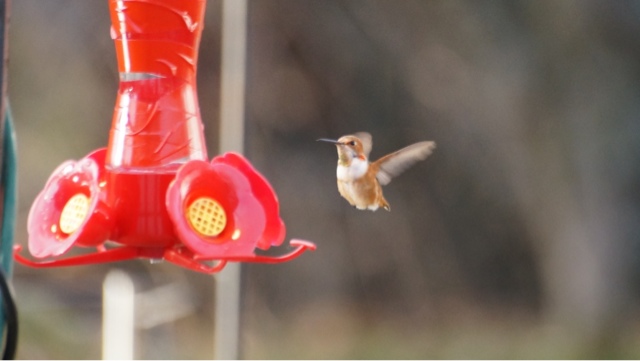


On Thursday afternoon I set out, by car, from Toronto to within an hour or so of Pipersville, Pennsylvania, so I could get an early look at the Allen's Hummingbird frequenting a feeder in in Babe Webster's backyard on Stump Road. Pipersville is about 30 minutes off the nearest highway, and as it turns out, only six miles from Peace Valley Park, where the Pink-footed Goose is still residing. Fact is, this wayward hummer was there when I had come to see the Pink-footed Goose, but for some reason wasn't on my radar.
Driving through the small towns leading to Pipersville, probably isn't much different than driving through Small Town British Columbia, and when I arrived at the specified address on Stump Road, I didn't have to wait long to see a kindly, white haired woman out putting food in her feeders, in the back yard. I drove partly up her driveway, got out and introduced myself. It was nearly like when Steve Martin's character, Stu, met the homeowner in The Big Year. Se was friendly, talkative and showed me right to the best viewing spot for the Allen's. Babe could have been the woman from the movie.
But there was a difference. My humming bird host has birded for and lived in the same housr for nearly 53 years, and was on Attu island at least once with Sandy Komito. She shared stories of her lifetime of birding adventures and I shared stories of my first year birding adventures. She was fun to talk to, admitting that at one point in Attu she broke down in tears, having stuggled with the weather and biking, asking herself what the heck she was doing in such a desolate place. While we chatted, we did, every so often, we remember to look up at her deluxe hummingbird feeder and view the Allen's as it came in for breakfast. And this little guy dines in style. This is indeed Babe's pampered baby. The feeder is kept full with warmed sugar water and even has a heat lamp built in. Though Babe is quite fond of her visitor, she would prefer it head back to the southwest and warmer weather sooner than later.
When this bird originally appeared back in November, it was thought to be a Rufous Hummingbird, and it had, in fact, arrived 10 years to the day that Babe had a Rufous in her back yard. However, a savvy and experienced local birder, scott Weidensaul was able to catch it for banding and identification,(mist netting, I assume), and examine and measure it in hand to determine it to be a 1st year male. I had been too early in January and too late in in the fall to get this guy on the west coast, so consider myself lucky to have counted year bird 592 in a Pennsylvania backyard. I signed her guest book,(I was visitor number 206), before I left and considered myself lucky to have met one of the more interesting characters in my year long quest.
Thursday, 27 December 2012
Happy Holiday Birding
I am heading out on the road one last time this year. I've been busy with the holidays at home and haven't been out chasing since the Rough-legged Hawk. Sue and I did spend Christmas Day birding at Humber Bay East and James Gardens, but mostly I've just been home and deciding how to finish off the year. I was unable to book any flights with my air miles to take me anywhere where I could get 9 more species this year, so 600+ will have to wait for another year. Most of the flights I could book from Toronto would have me leaving on December 30 and returning sometime in January. No thanks, Aeroplan.
The only flight I could get with my air miles, was from Baltimore to Miami. So I will drive down to Maryland,(there is a Tufted Duck there), and on to Miami where maybe the Western Spindalis will hang around just for me. I would also like to see a White-crowned Pigeon. On the way back I will check out some birds in New Jersey and perhaps be in the right place at the right time for a Dovekie.
There has been no sign of the Smew that visited Whitby Harbour this time last year. That would have been a great bird to end the year with, since it was the first bird I chased, last January 1. Oh well. Another year in another place perhaps.


The only flight I could get with my air miles, was from Baltimore to Miami. So I will drive down to Maryland,(there is a Tufted Duck there), and on to Miami where maybe the Western Spindalis will hang around just for me. I would also like to see a White-crowned Pigeon. On the way back I will check out some birds in New Jersey and perhaps be in the right place at the right time for a Dovekie.
There has been no sign of the Smew that visited Whitby Harbour this time last year. That would have been a great bird to end the year with, since it was the first bird I chased, last January 1. Oh well. Another year in another place perhaps.
Humber Bay East:


Backyard birding:


Back Yard Squirrelling?

Christmas Cheer from Amber and friend...

Saturday, 22 December 2012
Kind of a Rough Day
It was one of those days. I was late getting out the door this morning, barely made it to the Amherst Island Ferry on time, nearly got my car stuck in a rut on the side of the road, got lost in Owl Woods, and would still be there if not for having marked my parking spot on my GPS. I also ran out of gas on my way back to Toronto, after a brief side trip to see if I could find the Western Tanager that was in an Oshawa Park. Didn't.
I did have a brief look at a Barred Owl in Owl Woods, but spent the better part of three hours driving the roads in search of one of four Rough-legged Hawks that had been seen on the island in the last week. Finally, with half an hour before I needed to get to the ferry docks, I found a hawk in a tree out in a field. I had time to check it out with my binoculars and establish it was one of the Rough-legged Hawks, and then went to grab one of the cameras I brought with me to record the momentous event.
The first one I grabbed, our Canon with the 35x zoom lens that would have taken a good photo at that distance, had a dead battery. My Sony zoom lens wasn't long enough to get any kind of photo at that distance, and the sun was almost exactly behind the bird anyway. Plan C: I grabbed my scope, and would get a digiscope shot with my iPhone. Alas, before I even had the tripod set up the bird flew.
So, all in all, it was a rough day. But in a good way. I'll trade being lost in the woods and running out of gas for a Rough-legged Hawk any day of the year. Especially when the days of the year are running down to a precious few. 591 birds down, 9 to go for 600 with only 9 days remaining in the year. At this point 600 would be gravy. With family get-togethers over the next two days, I will have to run full steam afterwards, until the sun sets on New Year's Eve.
I did have a brief look at a Barred Owl in Owl Woods, but spent the better part of three hours driving the roads in search of one of four Rough-legged Hawks that had been seen on the island in the last week. Finally, with half an hour before I needed to get to the ferry docks, I found a hawk in a tree out in a field. I had time to check it out with my binoculars and establish it was one of the Rough-legged Hawks, and then went to grab one of the cameras I brought with me to record the momentous event.
The first one I grabbed, our Canon with the 35x zoom lens that would have taken a good photo at that distance, had a dead battery. My Sony zoom lens wasn't long enough to get any kind of photo at that distance, and the sun was almost exactly behind the bird anyway. Plan C: I grabbed my scope, and would get a digiscope shot with my iPhone. Alas, before I even had the tripod set up the bird flew.
So, all in all, it was a rough day. But in a good way. I'll trade being lost in the woods and running out of gas for a Rough-legged Hawk any day of the year. Especially when the days of the year are running down to a precious few. 591 birds down, 9 to go for 600 with only 9 days remaining in the year. At this point 600 would be gravy. With family get-togethers over the next two days, I will have to run full steam afterwards, until the sun sets on New Year's Eve.
Thursday, 20 December 2012
Hoary Hawk-Owl, Birdman!
The journey to see the Northern Hawk Owl actually started in mid October, when I drove up to Hilliardton Marsh to meet Bruce Murphy, the Bird,(banding),man himself, to see a Boreal Owl. It was worth the 5 hour + drive to see that bird and meet a some really nice and committed birders. At the time I asked about Northern Hawk Owls and Bruce promised to help me find them when they arrived in late December. And one,(maybe two), did during their annual Christmas Bird Count. I made plans to go see it, along with Hoary Redpolls coming to his feeder at the banding station.
Sure there were Northern Hawk Owls closer to home, including in Peterborough, but it's not always about where the bird is, but who you get to see the bird with. And I have been looking forward to returning to Hilliardton Marsh in the daylight, and meeting up with Bruce and Maggie, whom I also met at Boreal Owl watch. Turns out, in the daylight, Hilliardton Marsh looks very similar to the Zax/Zim Bog.
We had met a little earlier at the Husky Station in New Liskeard, Ontario, which I was lucky to even get to, as their own web site had directed me to a Mac's Milk five Kilometres away. I ended up getting there early, so enjoyed toast and coffee in the diner. Soon after, Bruce arrived, followed by Maggie. She had also been at the Yellow Rice and Rails festival but we never crossed paths out in the field.
I followed in my car and after scanning the trees in the fields Bruce stopped his car and got out. I saw no sign of a Northern Hawk Owl or any life. But Maggie had spotted it in a tree about 200 yards away. We got a great look at it through my scope, but none of the pictures were that good. I dropped a pin on my iPhone map so I could find my way back later.
Meanwhile we went back to the banding station and stood freezing in the cold, watching Common and Hoary Redpolls coming to the feeders, along with Pine and Evening Grosbeaks. Bruce and Maggie would point out the few Hoarys from the large flock of Commoners. The Hoary Redpolls, had an overall more "frosty" appearance. Over the course of twenty minutes or so, I got to see a good handful of the Hoary Redpolls mixed in with the rest of the flock. They were cute, and would fly in as a group, stay for a bit, like seniors on a day trip to the mall, and with seemingly no provocation, all leave for the trees in an instant.
Once we were too cold to stand there any longer,(both Maggie and I commented on how our thumbs were particularly cold), and had seen plenty of the Hoary guys, we set off in search of a local Great Gray Owl, that has been sitting up fairly close to the road. We drove to all the sights it had been seen, but no luck on this day. I didn't need it for my year list, but any time you get to see a Great Gray, you want to take the time to check it out.
Afterwards Bruce and Maggie bid me farewell and I had thanked them profusely for their time, I drove back, with the help of my GPS App, to the spot where the Hawk Owl had been and arrived just on time to see it dining on a delectable little mouse. I enjoyed the dinner show and got to take a few good photos, including a nice closeup through my scope using my iPhone. Up close, it was even better, as I could really see what a beautiful bird the Norther Hawk Owl really is. The sky was overcast, so the pictures don't really show what I saw through my scope. I stayed until it flew off onto another dead tree way in the distance and at that point set off on the long drive home. I will finish 2012 having seen 16 owl species of 18 rated lower than code 5. My only misses were the Flamulated and Ferruginous Pygmy Owls.
And with less than two weeks left in the Big Year, I am heading to the finish line with 590 species seen or heard in 2012. Can I find 10 birds in 12 days? Good question. I've already seen 17 birds in the first 20 days of December, so who knows. On January 1 of this year, time seemed to be in abundance, and now as it approaches again, time has become just as much a nemesis as these last 10 birds.
Where to go next? Hmmmmmmm....


Monday, 17 December 2012
Weekend Update
On Friday evening I set out for Massachusetts. I had been driving or birding the entire time and had had very little sleep. But the birding was great down there and the people I met even better. I drove all night to get to Bridgewater, MA by morning to find the Northern Lapwing in a corn field. There were already two birders present, but they had yet to find it. We crisscrossed the fields, looking into the sheared off corn stalks, appearing more like CSI's looking for evidence than birders looking for a rare code 4 bird. The sun was out and it wasn't too cold, so the walking was quite pleasant.
Eventually more birders showed up and it wasn't long before someone had seen the Lapwing at the opposite end of the field from where it had been reported, walking and feeding amongst stumps of stalks. We all had great looks at it and enjoyed finding out how far each of us had all driven for this bird. I think I had driven the furthest. I struck up a conversation with Chris, from Florida, who had traveled even more miles than me for the Lapwing, though he flew. We both wanted to see the Little Egret so agreed to meet an hour or so later at Kalmus Beach in Barnstable, MA.
We started where the Little Egret, which looks nearly identical to a Snowy Egret, had last been seen, but over the next four hours we and other birders were unable to locate it. Fact was, it had it hadn't been seen the last two days. Not that the trip was a bust. Chris and I had split up so we could cover more ground and, while we still continued to look for the Egret, we were also scanning for a Black-headed Gull. I wasn't having any luck, but Criss found one at Keys Beach, on a jetty, with some other gulls and a couple of Brant. We were able to watch it for a good while before it took off and landed not far off in the water. It stayed there for a bit then flew off.
We returned to our starting spot and staked out the water area when more birders showed up, with Big Hopes we had seen the Little Egret. Alas, no. But down at the beach one of the new arrivals had some Common Eiders in his scope. Bonus! Another bird for the Big Year. I stayed until the sun started to set on our Egret Watch, and decided I would get a start on my drive to Boston. One of the birders at the beach had just come from the Fenway Victory Gardens where they had a wayward MacGilvary's Warbler. That was a bird I hadn't found on any western trips and had given up on as a bird I would see this year.
I got to the Victory Gardens, across from fabled Fenway Park about 8:30 on a cold, gray morning. These privately held gardens were once part of the war effort, all across the US, Canada and abroad. During the first and second World Wars they grew fruit, vegetables and herbs in order to reduce the reliance on farmed produce. They also helped boost the moral, as it gave those left behind a sense of purpose in supporting the war effort back home. Now, they are private retreats for local tenants. Some are kept up meticulously and rival any home garden, and others are in need of a little, or in some cases, a lot of a TLC.
Upon my arrival I was immediately told that just an hour earlier the MacGilvary's, Nashville and a Golden-crowned Kinglet had all been in a bush near where I had entered. Within half an hour there were nearly a dozen birders present and all those eyes eventually led to our first look at the MacGilvary's. It was in a thicket, and though we could get good looks, a photo was difficult. One local birder, Justin, did get a picture good enough to confirm the identity, but mine just showed the bush and a blur. Over the course of the rest of the morning, myself and two guys named David scoured the gardens for another look. Every time we ran into another birder, I introduced ourselves to them. "Hi, I'm Robert and this is my birding friend, David and this is my other birding friend, David." As the morning wore on, we had more than our fair share for looks at the Nashville and were quite frankly getting tired of thinking we finally had the target bird, only to find out differently each time.
While one of the David's and I were down one row, the other David called the David I was with and alerted us to his confirmed MacGilvary's sighting. We ran as fast as the binoculars slapping against our chests would allow, but it was gone by the time we arrived. David Number One had a picture, and we knew the bird had not gone far. In fact, within 10 minutes I spotted it and for the next 10 minutes or so all present got fantastic looks at this rare east coast visitor, and those with cameras got some nice photos.
I am home now, 4 birds on the plus side and a new total of 588 for the year. Wednesday I head up to Hilardton Marsh for Northern Hawk Owl and Hoary Redpolls courtesy of Bruce Murphy, the intrepid northern Ontario bird bamder.


Eventually more birders showed up and it wasn't long before someone had seen the Lapwing at the opposite end of the field from where it had been reported, walking and feeding amongst stumps of stalks. We all had great looks at it and enjoyed finding out how far each of us had all driven for this bird. I think I had driven the furthest. I struck up a conversation with Chris, from Florida, who had traveled even more miles than me for the Lapwing, though he flew. We both wanted to see the Little Egret so agreed to meet an hour or so later at Kalmus Beach in Barnstable, MA.
We started where the Little Egret, which looks nearly identical to a Snowy Egret, had last been seen, but over the next four hours we and other birders were unable to locate it. Fact was, it had it hadn't been seen the last two days. Not that the trip was a bust. Chris and I had split up so we could cover more ground and, while we still continued to look for the Egret, we were also scanning for a Black-headed Gull. I wasn't having any luck, but Criss found one at Keys Beach, on a jetty, with some other gulls and a couple of Brant. We were able to watch it for a good while before it took off and landed not far off in the water. It stayed there for a bit then flew off.
We returned to our starting spot and staked out the water area when more birders showed up, with Big Hopes we had seen the Little Egret. Alas, no. But down at the beach one of the new arrivals had some Common Eiders in his scope. Bonus! Another bird for the Big Year. I stayed until the sun started to set on our Egret Watch, and decided I would get a start on my drive to Boston. One of the birders at the beach had just come from the Fenway Victory Gardens where they had a wayward MacGilvary's Warbler. That was a bird I hadn't found on any western trips and had given up on as a bird I would see this year.
I got to the Victory Gardens, across from fabled Fenway Park about 8:30 on a cold, gray morning. These privately held gardens were once part of the war effort, all across the US, Canada and abroad. During the first and second World Wars they grew fruit, vegetables and herbs in order to reduce the reliance on farmed produce. They also helped boost the moral, as it gave those left behind a sense of purpose in supporting the war effort back home. Now, they are private retreats for local tenants. Some are kept up meticulously and rival any home garden, and others are in need of a little, or in some cases, a lot of a TLC.
Upon my arrival I was immediately told that just an hour earlier the MacGilvary's, Nashville and a Golden-crowned Kinglet had all been in a bush near where I had entered. Within half an hour there were nearly a dozen birders present and all those eyes eventually led to our first look at the MacGilvary's. It was in a thicket, and though we could get good looks, a photo was difficult. One local birder, Justin, did get a picture good enough to confirm the identity, but mine just showed the bush and a blur. Over the course of the rest of the morning, myself and two guys named David scoured the gardens for another look. Every time we ran into another birder, I introduced ourselves to them. "Hi, I'm Robert and this is my birding friend, David and this is my other birding friend, David." As the morning wore on, we had more than our fair share for looks at the Nashville and were quite frankly getting tired of thinking we finally had the target bird, only to find out differently each time.
While one of the David's and I were down one row, the other David called the David I was with and alerted us to his confirmed MacGilvary's sighting. We ran as fast as the binoculars slapping against our chests would allow, but it was gone by the time we arrived. David Number One had a picture, and we knew the bird had not gone far. In fact, within 10 minutes I spotted it and for the next 10 minutes or so all present got fantastic looks at this rare east coast visitor, and those with cameras got some nice photos.
I am home now, 4 birds on the plus side and a new total of 588 for the year. Wednesday I head up to Hilardton Marsh for Northern Hawk Owl and Hoary Redpolls courtesy of Bruce Murphy, the intrepid northern Ontario bird bamder.
Part of the the B.S.I. Team,(Bird Scene Investigators)

Northern Lapwing:

Black-headed Gull - Winter Plumage:
Nashville Warbler:
MacGilvary's Warbler:
Common Eiders:
Wednesday, 12 December 2012
It Was a Black-eyed, Yellow-legged, Walking Purple Sandpiper
Editor's Note: This is an earlier blog post, from December 1, 2012. I changed the title and it popped it up to the top... the newest post is below, "The Patagonia Key."
And finally, it was on my list, with almost no effort at all. I had planned the morning to go into work and prepare for my business trip to Nashville, and the afternoon for driving to Elmira for Rough-legged Hawks and some cheese balls from Kitchen Kuttings. If you've not tried them before, take the drive to Elmira and find out for yourself, the cheese balls, not the Hawks.
But my day didn't go anywhere near as planned. I was at work for longer than I had anticipated, then when I finally was on the road to Elmira, I had to turn around and head back to downtown Toronto and take care of something else. In the meantime, OntBirds came through with a report of a Purple Sandpiper working the beach at Bronte Harbour in Oakville, thanks to the keen eye of Mark Jennings. Well that changed everything. I had missed the Purple Sandpipers on at least three trips to Presqu'ile Provincial Park the past few weeks.
As soon as I wrapped up things at work, I jumped in the car and headed 30 minutes down the QEW to Bronte Harbour. I overshot the parking lot, had to make a tight turn at the end of a road down at the lake, park the car, then re-park the car closer to the beach, and as I walked down the path was directed to the bird by a gentleman who was running back for his camera, having not expected the bird to be so close.
As it turned out, it was right there in front of us, feeding and walking about in the water and on the rocks, putting on a wonderful show for all present. Cutest little sandpiper I've seen. We all watched for about 10 or 15 minutes, everyone taking photos. I even ran into Clive, with whom I shared an afternoon of birding in Hamilton, waiting for sunset to see the Short-eared Owls. Around half a dozen birders were present before I headed out to search for the Rough-legged Hawks.
Alas, the only raptor I saw the rest of the afternoon was a Red-tailed, on a poll on the way up to Elmira. However I did get the cheese balls, so I can't complain. Sometimes the best days are the ones that aren't planned.
So, we are now into the home stretch. The Purple Sandpiper was number 573 on my Big Year. For me it is a significant number. When I realized I would see in excess of 500 birds this year, I made it a goal to get to and pass 572. 572 is the number of birds Roger Tory Peterson saw in 1953, the year he set out on his Wild America Adventure. Perhaps my year has not been quite so wild, but though I am not stopping yet, hitting and passing my goal has felt pretty good.


And finally, it was on my list, with almost no effort at all. I had planned the morning to go into work and prepare for my business trip to Nashville, and the afternoon for driving to Elmira for Rough-legged Hawks and some cheese balls from Kitchen Kuttings. If you've not tried them before, take the drive to Elmira and find out for yourself, the cheese balls, not the Hawks.
But my day didn't go anywhere near as planned. I was at work for longer than I had anticipated, then when I finally was on the road to Elmira, I had to turn around and head back to downtown Toronto and take care of something else. In the meantime, OntBirds came through with a report of a Purple Sandpiper working the beach at Bronte Harbour in Oakville, thanks to the keen eye of Mark Jennings. Well that changed everything. I had missed the Purple Sandpipers on at least three trips to Presqu'ile Provincial Park the past few weeks.
As soon as I wrapped up things at work, I jumped in the car and headed 30 minutes down the QEW to Bronte Harbour. I overshot the parking lot, had to make a tight turn at the end of a road down at the lake, park the car, then re-park the car closer to the beach, and as I walked down the path was directed to the bird by a gentleman who was running back for his camera, having not expected the bird to be so close.
As it turned out, it was right there in front of us, feeding and walking about in the water and on the rocks, putting on a wonderful show for all present. Cutest little sandpiper I've seen. We all watched for about 10 or 15 minutes, everyone taking photos. I even ran into Clive, with whom I shared an afternoon of birding in Hamilton, waiting for sunset to see the Short-eared Owls. Around half a dozen birders were present before I headed out to search for the Rough-legged Hawks.
Alas, the only raptor I saw the rest of the afternoon was a Red-tailed, on a poll on the way up to Elmira. However I did get the cheese balls, so I can't complain. Sometimes the best days are the ones that aren't planned.
So, we are now into the home stretch. The Purple Sandpiper was number 573 on my Big Year. For me it is a significant number. When I realized I would see in excess of 500 birds this year, I made it a goal to get to and pass 572. 572 is the number of birds Roger Tory Peterson saw in 1953, the year he set out on his Wild America Adventure. Perhaps my year has not been quite so wild, but though I am not stopping yet, hitting and passing my goal has felt pretty good.
The Patagonia Key, by,(with), Matt Brown
We didn't have to start so early on Monday morning. 7:30 was a fine time to begin for the birds I was after. And the key to getting them was to begin after sunrise in Patagonia. It being quail hunting season, Matt and I were going to have one last "audio-visual" hunt for the elusive and rarely seen Montezuma Quail, sometimes referred to as mythical, since so many birders rarely see or hear it. There was also word of a Ruddy Ground-Doven in Patagonia Lake State Park, and while there we would work on both the Hammond's and Dusky Flycatchers. And if time permitted, a drive north of Tucson for another rarity, a Mexican vagrant, know as a Rufous-backed Robin. Another intense" but fun day of target birding with Matt. Just the way we like it.
After a coffee at the Gathering Gounds, we set up into the hills and spent the morning looking and listening for the Montezuma Quail. It was adventure hiking, to say the least, with spiked bushes and barbed things clinging to our pants and shoes. Matt played the quail call and we walked and listened. We could definitely see signs of their presence, as they leave distinctive scratch marks in the soil. Finally, as we walked, we heard a clearly identifiable answer to our Montezuma Quail calls. Later we would hear them calling from another location. Matt was relieved as he didn't want me to leave Arizona believing that these birds were, indeed mythical.
Next we were off to Patagonia Lake State Park. This would be my third trip there this year. I had just recently seen the Elegant Trogon, but there had been few, if any, flycatchers that day. Of course, I was focused on the Trogon, so may have missed them. This day, we would here for the Ruddy Ground-Dove and a couple of flycatchers. We started at the visitor's centre and it took no time at all to find a female Ruddy Ground-Dove, not on the ground as its name would have you believe, but in a tree. There were supposed to be two males, but they were MIA. Good thing we made our first stop for the Ruddy's, because when we returned later for the males, there were no doves of any species to be seen.
Having had good looks at the dove, we headed down to the birding trail, where once Sandy Komito had seen the Nutting's Flycatcher at the beginning of his record setting Big Year. A much easier place to get to that the Bill Williams River NWR. We were on the hunt for the Hammond's and Dusky Flycatchers, and once we got to their preferred habitat, Matt began playing the calls. Well, wouldn't you know it, the Hammond's flew in right away and we got spectacular looks at it. Matt pointed out the flatter head, as though a cartoon anvil had landed on it. It didn't take long for the Dusky to show up either. Within ten minutes we had great looks at both.
Matt still hadn't seen the Trogon this year, and in fact, since I saw it, it has not been reported very much at all. We kept an eye out for it, but couldn't locate it near where i had found it last time. Good thing I wasn't counting on it for this trip, or I would have been quite disappointed.
But it was another very successful day of target birding with Matt. Over the course of the year I have counted 31 year birds in the Patagonia area and 17 in the park itself. But there were two more birds to look for before heading home. There were reports of a Rufous-backed Robin and Rosy-faced Lovebirds had just been added to the ABA list. I had to drive back to Tucson and then over to Phoenix, where I was flying home from, in order to bag those last two.
I drove up to Sabino Canyon Recreation Area but it was too late in the day to find the robin. I ran into a gentleman who birds on weekends and business trips, whom I had met in Texas, along the trail. Hemant was in the area for work and was birding the park, having no idea that the robin was around. We looked together the first evening, but it turned out the bird we were chasing was likely a Black-throated Sparrow, based on the photo I took the next morning in the same bush.
Since it was getting dark, we decided to call it a night and come at daybreak the next morning. I had really wanted to see it that night so I could get to Phoenix and stake out the Rosy-faced Lovebirds at dawn the next morning. I could only hope to get the robin quickly the next morning and still have time before my flight to see the Lovebirds.
I arrived just as the sun was coming up on Tuesday morning and headed to the same spot as the previous day. Except, I had been following Hemant the night before and I saw a sign for Sabino Dam East and West. I didn't remember which way I had gone, so contacted Matt via text message for a little guidance. Turned out that either way basically took you to the same place. I met up with Hemant and we ran into a couple of hikers who had seen the bird the previous year and helped guide is to the exact right place to look.
But, there was no robin at all. In fact, it had not been seen the previous day, and we decided to scout the entire area in case it was foraging elsewhere. Eventually we split up to increase the odds. Finding no sign of rufousness below the dam, I headed back to where it had originally been seen, and as I entered the area just above the dam I heard it's chip call. It took me only a couple of minutes to chase it down, on and over and under some tree limbs, but then it tired of running and just hung out on a log long enough for a photo. It moved around, I chased it, and got some more good looks and photos.
I needed to get on the road for Phoenix, as it was getting late, but first chased down Hemant and directed him to the bird. I hope he got his photos. I rushed off to the car, but not before getting a nice photo of a Phainopepla posing nicely atop a tree. After a two hour drive to Phoenix, I only had an hour to scout around for the Rosy-faced Lovebirds, but ran out of time and had to catch my flight. I was glad of my decision to stay for the Rufous-backed Robin, though. The Lovebirds hadn't even been on my radar,(birdar?), until I arrived.
I left returned home having added 10 new year birds on my trip through Texas and Arizona and I left Arizona with over 140 Arizona species and 584 species for my Big Year. 16 to go. Long shot, but worth trying for over the next 3 weeks. I couldn't have done any of it without the amazing help of Melody Kehl and Matt Brown. Please look them up next time you're in Arizona.


The rufous back:


Made this while waiting for the Nutting's to return after my initial look

The crazy, scary road in Bill Williams River NWR that nearly broke my rental car


After a coffee at the Gathering Gounds, we set up into the hills and spent the morning looking and listening for the Montezuma Quail. It was adventure hiking, to say the least, with spiked bushes and barbed things clinging to our pants and shoes. Matt played the quail call and we walked and listened. We could definitely see signs of their presence, as they leave distinctive scratch marks in the soil. Finally, as we walked, we heard a clearly identifiable answer to our Montezuma Quail calls. Later we would hear them calling from another location. Matt was relieved as he didn't want me to leave Arizona believing that these birds were, indeed mythical.
Next we were off to Patagonia Lake State Park. This would be my third trip there this year. I had just recently seen the Elegant Trogon, but there had been few, if any, flycatchers that day. Of course, I was focused on the Trogon, so may have missed them. This day, we would here for the Ruddy Ground-Dove and a couple of flycatchers. We started at the visitor's centre and it took no time at all to find a female Ruddy Ground-Dove, not on the ground as its name would have you believe, but in a tree. There were supposed to be two males, but they were MIA. Good thing we made our first stop for the Ruddy's, because when we returned later for the males, there were no doves of any species to be seen.
Having had good looks at the dove, we headed down to the birding trail, where once Sandy Komito had seen the Nutting's Flycatcher at the beginning of his record setting Big Year. A much easier place to get to that the Bill Williams River NWR. We were on the hunt for the Hammond's and Dusky Flycatchers, and once we got to their preferred habitat, Matt began playing the calls. Well, wouldn't you know it, the Hammond's flew in right away and we got spectacular looks at it. Matt pointed out the flatter head, as though a cartoon anvil had landed on it. It didn't take long for the Dusky to show up either. Within ten minutes we had great looks at both.
Matt still hadn't seen the Trogon this year, and in fact, since I saw it, it has not been reported very much at all. We kept an eye out for it, but couldn't locate it near where i had found it last time. Good thing I wasn't counting on it for this trip, or I would have been quite disappointed.
But it was another very successful day of target birding with Matt. Over the course of the year I have counted 31 year birds in the Patagonia area and 17 in the park itself. But there were two more birds to look for before heading home. There were reports of a Rufous-backed Robin and Rosy-faced Lovebirds had just been added to the ABA list. I had to drive back to Tucson and then over to Phoenix, where I was flying home from, in order to bag those last two.
I drove up to Sabino Canyon Recreation Area but it was too late in the day to find the robin. I ran into a gentleman who birds on weekends and business trips, whom I had met in Texas, along the trail. Hemant was in the area for work and was birding the park, having no idea that the robin was around. We looked together the first evening, but it turned out the bird we were chasing was likely a Black-throated Sparrow, based on the photo I took the next morning in the same bush.
Since it was getting dark, we decided to call it a night and come at daybreak the next morning. I had really wanted to see it that night so I could get to Phoenix and stake out the Rosy-faced Lovebirds at dawn the next morning. I could only hope to get the robin quickly the next morning and still have time before my flight to see the Lovebirds.
I arrived just as the sun was coming up on Tuesday morning and headed to the same spot as the previous day. Except, I had been following Hemant the night before and I saw a sign for Sabino Dam East and West. I didn't remember which way I had gone, so contacted Matt via text message for a little guidance. Turned out that either way basically took you to the same place. I met up with Hemant and we ran into a couple of hikers who had seen the bird the previous year and helped guide is to the exact right place to look.
But, there was no robin at all. In fact, it had not been seen the previous day, and we decided to scout the entire area in case it was foraging elsewhere. Eventually we split up to increase the odds. Finding no sign of rufousness below the dam, I headed back to where it had originally been seen, and as I entered the area just above the dam I heard it's chip call. It took me only a couple of minutes to chase it down, on and over and under some tree limbs, but then it tired of running and just hung out on a log long enough for a photo. It moved around, I chased it, and got some more good looks and photos.
I needed to get on the road for Phoenix, as it was getting late, but first chased down Hemant and directed him to the bird. I hope he got his photos. I rushed off to the car, but not before getting a nice photo of a Phainopepla posing nicely atop a tree. After a two hour drive to Phoenix, I only had an hour to scout around for the Rosy-faced Lovebirds, but ran out of time and had to catch my flight. I was glad of my decision to stay for the Rufous-backed Robin, though. The Lovebirds hadn't even been on my radar,(birdar?), until I arrived.
I left returned home having added 10 new year birds on my trip through Texas and Arizona and I left Arizona with over 140 Arizona species and 584 species for my Big Year. 16 to go. Long shot, but worth trying for over the next 3 weeks. I couldn't have done any of it without the amazing help of Melody Kehl and Matt Brown. Please look them up next time you're in Arizona.
Ruddy Ground-Dove

Hammond's Flycatcher


Dusky Flycatcher


Rufous-backed Robin

The rufous back:

Phainopepla

Sandhill Cranes in Texas

Verdin where I wish the Nutting's had landed in Bill Williams River NWR

Barrow's and Common Goldeneyes, together at the BW NWR Visitors Center

Made this while waiting for the Nutting's to return after my initial look

The crazy, scary road in Bill Williams River NWR that nearly broke my rental car

Subscribe to:
Posts (Atom)